
For decades, making partner at a major accounting firm was viewed as one of the safest career outcomes in the CPA profession.
You worked through the system, built a book, carried client relationships and eventually, you earned a seat at the table.
But that table is changing.
On April 24 2026, KPMG was reported to be cutting roughly 10% of its U.S. audit partners, with around 100 partners expected to leave the firm after voluntary retirement efforts did not go far enough. The move is being positioned as part of a reshaping of the audit practice to better align the partnership with the size, structure and future needs of the business.
This is not just a layoff story. It is a signal about the accounting profession.
The old partnership model is being stress-tested.
Partner count, leverage, retirement timing, productivity, technology and client demand are all being recalibrated at the same time. And if this is happening inside the Big Four, it is absolutely happening more quietly inside small and mid-sized CPA firms.
The partnership model is being repriced
Most CPA firm owners already understand this instinctively.
The value of a firm is no longer based only on historical revenue, partner relationships or a stable client base. In today’s market, other factors are becoming just as important.
Can the next generation lead?
Is revenue concentrated around one or two senior partners?
Is the existing staff model sustainable?
Is the firm growing or simply surviving busy season every year?
The KPMG news simply makes the issue more visible.
Growth alone does not protect a partnership structure if the economics underneath it no longer work.
This is not only a Big Four issue
Large firms make visible changes because their scale makes the math obvious.
But small and mid-sized CPA firms are dealing with the same pressure in a quieter way. In many local firms, succession is not a boardroom strategy, it is a conversation that gets pushed off until after tax season.
A senior partner knows they are tired.
A younger partner may not want to buy in at the old valuation.
An income partner wants ownership but does not want to inherit a broken operating model.
The firm may still have revenue, loyal clients and a respected name in the market but the ownership structure is aging faster than the business model is evolving.
Partner exits are becoming a strategy, not a failure
The most interesting part of the KPMG story is not that partners are leaving.
It is that partner exits are being used as part of a strategic reshaping of the firm.
That is a major psychological shift for the profession.
For years, partnership was treated as the end goal. Once someone became partner, the assumption was that they would stay until retirement, manage their client base and eventually transition out on a predictable timeline.
That assumption is breaking.
The Big Four are starting to treat partnership less like a lifetime seat and more like an active ownership role. KPMG and EY have also reportedly moved some UK equity partners into salaried partner roles, another sign that firms are tightening who gets to participate in equity economics.
That may sound like a Big Four issue but the same question exists inside smaller firms too.
- Who is carrying the client relationships?
- Who is building the next layer of the firm?
- Who is creating value beyond simply holding the title?
- And who is expected to buy into a model that may no longer feel realistic?
This is where the old partnership playbook starts to break down.
If partnership is no longer a guaranteed destination at the largest firms in the profession, smaller firms cannot assume the next generation will automatically want to buy in either.
The real question for CPA firm owners
The question is no longer: “Will my firm sell?”
The better question is:
“Does the next generation know what ownership looks like here?”
That is where a lot of multi-partner firms get stuck.
A firm may have good revenue, strong clients and a respected name in the market. But if only a small group of partners hold equity, the future of the firm can become unclear very quickly.
Income partners may be doing the work of owners without knowing if they will ever become true equity owners. Younger partners may want a future in the firm but not at a valuation or structure that no longer feels realistic. Senior partners may assume succession is happening naturally, when in reality, the next generation is still trying to understand what they are being asked to buy into.
That gap is where succession pressure builds.
The firm may have loyal clients, steady revenue and a strong name in the market, but inside the partnership, the next chapter is no longer obvious to everyone.
And maybe that is the real question to leave you with this week:
What does the future of ownership look like inside your firm?
The RSSL Mergers view
At RSSL Mergers, we spend a lot of time looking at how CPA firms actually change hands.
Not just when a deal is announced, but before the deal exists.
We look at partner age mix, ownership structure, service lines, market position, succession risk and the signals that show when a firm may be approaching a transition point.
The KPMG partner cuts are a reminder that no part of the profession is immune to structural change.
- Not the Big Four.
- Not regional firms.
- Not small partnerships.
- Not solo owners.
In this market, optionality may become one of the most valuable assets a CPA firm owner has.
Ideagen Audit Analytics’ 2025 SEC audit market data
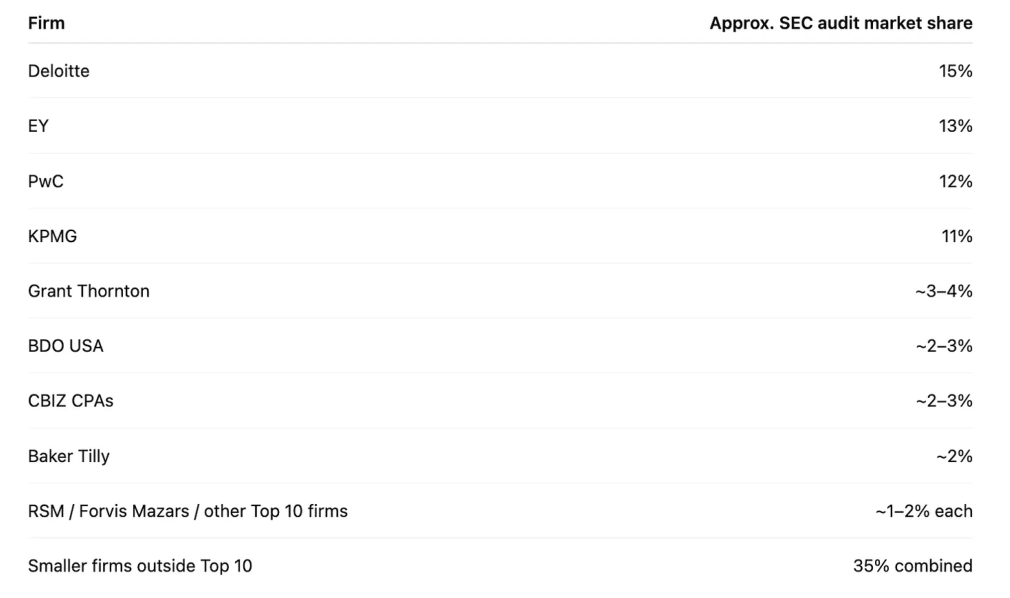
Sources: KPMG partner reduction details were reported by The Wall Street Journal and summarized by Accounting Today. SEC audit market share figures are based on Accounting Today’s summary of Ideagen Audit Analytics’ 2025 Who Audits Public Companies report. Big Four percentages are reported figures; mid-market firm percentages are approximate estimates based on the remaining Top 10 share.